Words · 정 · 11 min read
Jeong: the sticky Korean feeling English has no word for
What jeong (정) is, why Koreans say they share 'hateful jeong and lovely jeong', how it shows up in extra side dishes, market freebies, Choco Pies and neighbors' Tupperware, how it builds over time, and how a foreigner can earn it (and lose it).
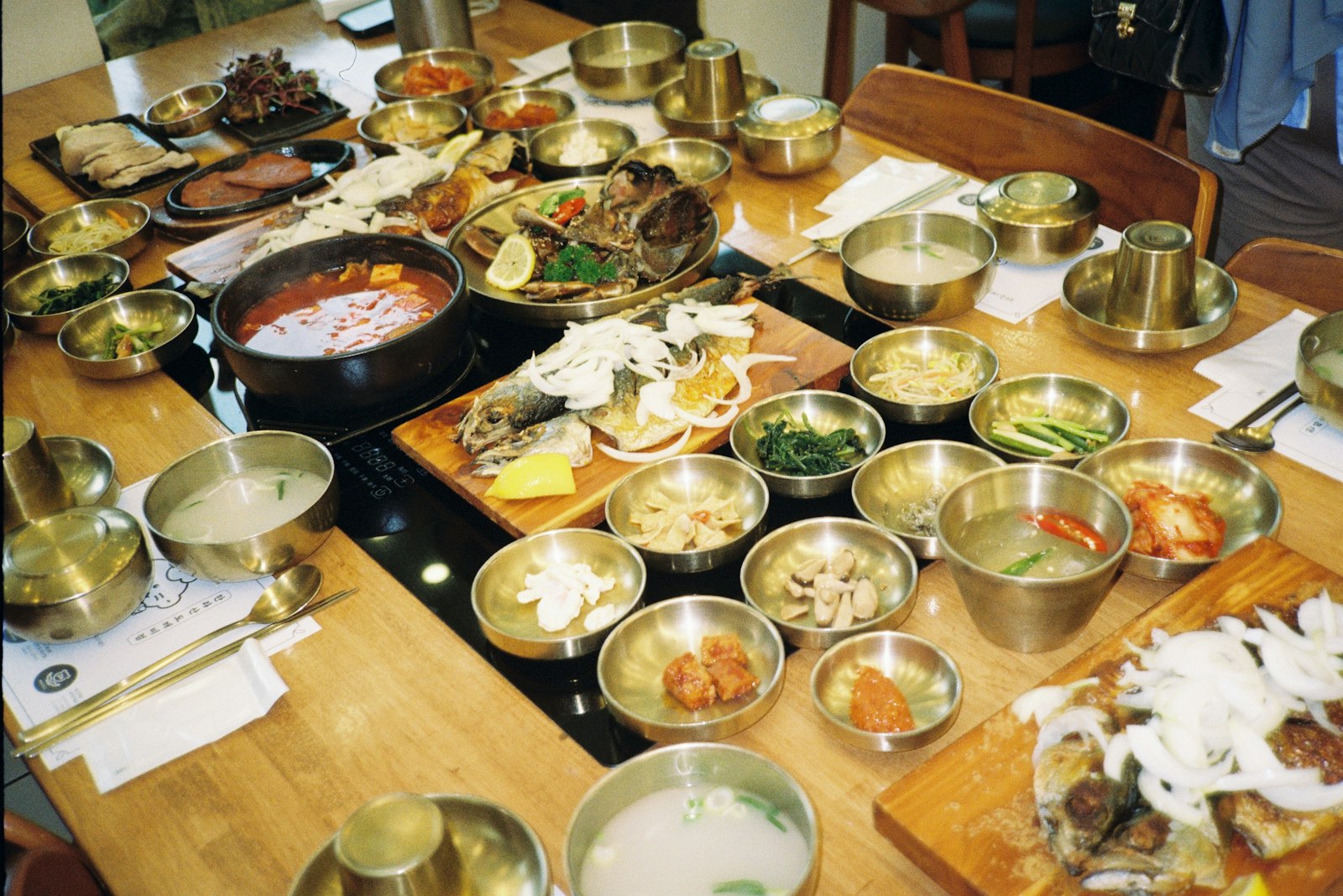
You’ve been going to the same little kimbap shop near your office for about three months. Same seat, same order, same nod. One Tuesday, the owner sets down your tray and there’s a boiled egg on it you didn’t order. Or a second helping of pickled radish. Or a small cup of fish-cake soup that, according to the menu on the wall, costs 1,000 won.
You look up. The owner is already back at the cutting board, not looking at you, very busy with a cucumber.
Congratulations. You didn’t get a discount. You got 정 (jeong).
The short version: jeong is the warm, sticky attachment that builds up between people (and between people and places) through time, shared food and small kindnesses. It’s not quite love, friendship, loyalty or affection, but it has a bit of all of them. It grows slowly, it’s shown far more than it’s said, it can include irritation as well as fondness, and once it’s there, Koreans find it very hard to walk away from. You earn it by showing up again and again, eating what you’re given, and giving a little back.
So what is jeong, exactly?
Ask ten Koreans to define 정 and you’ll get ten people staring into the middle distance, then saying “음… 그냥… 정이야” (“Um… it’s just… jeong”). That’s not evasion. It’s genuinely hard to pin down, even for people who live inside it.
The word comes from the Chinese character 情, which on its own means something like feeling or emotion. But the Encyclopedia of Korean Culture points out that although Koreans borrowed the character, they grew their own idea around it in everyday life, an idea that stretches well beyond the Confucian philosophers’ definitions. It’s a feeling and a way of acting, and it’s the thread that ties relationships together. The same entry notes that Koreans sometimes describe their own society as 정의 사회, a “society of jeong”.
A practical way to think about it:
- Love is often a choice or a spark. Jeong is more like sediment. It settles, layer by layer, whether you meant it to or not.
- Friendship is between equals who like each other. You can have jeong with the grumpy security guard of your apartment building, your old school, or the dented saucepan you’ve had since university.
- Loyalty is a principle. Jeong is a stomach feeling.
The Korean verb for it says it all: 정들다 (jeong-deul-da). The Standard Korean Language Dictionary defines it as jeong forming and deepening. Literally, jeong enters. Nobody decides to have it. One day you notice it’s moved in, unpacked, and is not leaving.
미운 정 고운 정: the hateful jeong and the lovely jeong
Here is the part that confuses foreigners most, and the part Koreans find most obvious.
There’s a common phrase, 미운 정 고운 정 다 들었다 (mi-un jeong go-un jeong da deu-reot-da): “Both the hateful jeong and the lovely jeong have built up.” The Encyclopedia of Korean Culture uses it to explain that jeong isn’t simple love but a love in which hatred and anger can live alongside fondness, and even be swallowed up by it.
In practice, it’s what you say about:
- the sibling who stole your clothes for twenty years and is now the first person you call
- the coworker you’ve argued with through four reorganizations and would defend to the death against the next department
- the long-married couple who bicker about the remote control every night and would be lost without each other
The fights are part of the bond, not a crack in it. Every argument you survived together is another layer of sediment. Korean dramas live on this: the two leads who spend the first eight episodes insulting each other are not enemies, they’re just building 미운 정 at a highly efficient rate.
Say / Mean: 미운 정 고운 정 다 들었어 (mi-un jeong go-un jeong da deu-reo-sseo) says “Both the hateful and the lovely jeong have built up.” It means “We’ve been through everything together, including annoying each other, and I’m not going anywhere.” It’s one of the most affectionate things you can say about a long relationship, even though half the sentence contains the word “hateful.”
Where you’ll see jeong (spoiler: it’s usually food)
Jeong is rarely announced. It’s handed to you, often in a plastic container with the lid slightly cracked.
The extra side dish. Korean restaurants already give you free refillable banchan. Jeong is when the owner brings something extra: a plate of fried egg, a bit more meat, a can of soda, delivered with the word 서비스 (“service”, meaning on the house). It tends to go to regulars, and to people who said “정말 맛있어요” loudly enough for the kitchen to hear.
덤 at the market. The dictionary defines 덤 (deom) as a little extra given free on top of what something is worth. At a traditional market, it’s the extra handful of bean sprouts, the one more tangerine tossed into the bag, the vendor saying “하나 더 넣었어” (“I put one more in”). It’s not a promotion with a barcode. It’s a person deciding they like you. And it creates a gentle obligation: next week, you come back to this stall, not the one across the aisle.
Mom’s side dishes. Every Korean who has moved out has received some version of this KakaoTalk message: “반찬 해놨다. 가지러 와.” (“I made side dishes. Come get them.”) Followed, if you don’t reply within the hour, by “바쁘냐” (“Busy?”), then a blurry photo of seven containers of kimchi, then “아빠가 갖다 준대” (“Your dad says he’ll drop them off”). Saying you have enough food is not an option. Your fridge will be filled. That’s jeong, operating at full pressure.
The neighbor’s Tupperware. Korean has a word for a neighbor who’s become as close as family: 이웃사촌 (i-ut-sa-chon), literally “neighbor-cousin.” The dictionary definition says it all: someone who lives nearby and, through jeong, has become as close as a cousin. The classic way it grows is food going back and forth. Someone brings over a plate of rice cakes when they move in, or jeon after a holiday. And there’s a common unwritten rule: you try not to return the plate empty. A few pieces of fruit, some cookies, anything. Returning an empty container is not wrong, exactly. It’s just a little bit… 정 없다 (jeong eop-da), “lacking jeong.”
Sharing everything. Food goes in the middle, everyone reaches in, and the person who brought snacks to the office breaks them open for the whole team. Eating a whole bag of chips alone at your desk while colleagues watch is legal. It’s just not very jeong.
The snack that trademarked a feeling: Choco Pie 情
If you want proof of how central jeong is to Korean life, look at the snack aisle.
Orion’s Choco Pie, the marshmallow-and-chocolate sandwich, launched in Korea in 1974. By the 1980s it had lots of lookalike competitors. According to Orion, in 1989 the company started its 정 campaign, and the snack became a national favorite. A 2026 Bizwatch retrospective describes the ads: postal workers, security guards, rural station staff and students passing on their feelings without words, often by leaving a Choco Pie behind. In one early ad, a teacher opens a desk drawer expecting a written apology from a student and finds a Choco Pie and a note instead.
Then came the jingle, from a 1992 ad, which Koreans of a certain age can still sing on command: “말하지 않아도 알아요, 눈빛만 보아도 알아” (“Even if you don’t say it, I know. Just one look in your eyes and I know”). That line is a near-perfect summary of jeong, and also of nunchi, which tells you how closely the two are related.
The character 情 is still printed on the Korean box. And when Orion took the snack abroad, the feeling needed translating too. Bizwatch reports that in China, where 情 could read as romantic love, the packaging used 仁 (benevolence) instead, while in Vietnam the brand used the local word Tình. Even a cookie company found out jeong doesn’t fit neatly into other languages.
How jeong builds: time, food and small debts
Jeong has no shortcut. You can’t buy it with one big gift, and you can’t get it from a single brilliant night out. It accumulates from repetition:
- Time. Seeing the same people again and again. Same office, same gym, same 국밥 restaurant. Familiarity is the soil.
- Shared hardship. Working late on the same doomed project, surviving the same military unit, cramming for the same exam. Suffering together is jeong fertilizer. It’s also why the people still at the table in the second round of a night out suddenly feel closer.
- Food. Being fed and feeding back. If you’ve been asked whether you’ve eaten by the same person enough times, you’re probably in.
- Small, uneven exchanges. A coffee here, a borrowed umbrella there, a tangerine passed across the desk. The key is that it’s never exactly balanced. If everything is settled to the won, the relationship is a transaction. If someone always “owes” a little, the relationship keeps going. Jeong lives in that slightly unbalanced ledger.
This is why some Koreans find perfectly split bills a bit cold, even as more and more people, especially younger Koreans, split them happily. It’s not about the money. “You got it last time, I’ll get it this time” is a way of promising there will be a next time.
There’s a quiet sadness built in, too. Because jeong grows from time, Koreans talk about how hard it is to leave something you’ve 정들었다 to: a neighborhood, a school, a job you complain about daily. You’ll hear people sigh 정들자 이별이네 (“just as jeong forms, it’s time to part”) at farewells for exactly this reason.
How it’s changing: jeong in the age of the doorbell camera
Jeong isn’t disappearing, but where it lives is shifting. Big apartment complexes, long working hours and delivery apps mean many people simply don’t bump into their neighbors much anymore.
A 2022 Embrain Trend Monitor survey of 1,000 Korean adults aged 19 to 59 found that only 55.9% knew who lived next door, down from 60.2% in the same survey in 2019. Willingness to interact with neighbors fell from 57.0% to 50.2%. The most common reasons for not mixing: there’s rarely a chance to run into them, and life isn’t inconvenient without it.
But read further and the old instinct is still there. In the same survey, 86.2% said they’d gladly help a neighbor in an emergency, and 82.3% said they’d like to have a 동네 친구, a friend in the neighborhood. People haven’t stopped wanting jeong. They just want it with less obligation, on their own schedule, ideally without a surprise knock at 8 p.m.
So it now shows up in newer places: the KakaoTalk group chat where someone sends a coffee voucher to the person who did the hard work, the online community where regulars recognize each other’s usernames, and the delivery rider who gets a bottle of cold water left by the door in August.
How to earn jeong as a foreigner
Good news: you don’t have to be Korean to get it. Koreans often extend jeong to foreigners quite generously, partly because effort from an outsider is so noticeable. Here’s what helps.
Be a regular. Pick a restaurant, a café, a market stall, a hairdresser, and keep going back. Learn to say “늘 먹던 걸로요” (“The usual, please”) and watch what happens. Owners remember faces, and on about the fifth visit your egg may appear.
Eat what you’re given, and praise it. When someone offers food, accept at least a little. “맛있어요!” repeated sincerely is the single best jeong-building sentence in the language.
Return the plate with something on it. If a neighbor or coworker brings you food, give the container back with fruit, cookies or a snack from your home country in it. Foreign snacks are a jeong cheat code: they’re interesting, they’re a conversation starter, and they show you thought of them.
Let the ledger stay a bit uneven. If someone buys you coffee, don’t immediately bank-transfer them 4,500 won. Buy the next one. Then let them buy the one after that. The point is to keep the loop open.
Show up when it counts. Weddings, funerals, a colleague’s farewell lunch, the team dinner you’d rather skip once in a while. Being there in bad times builds more jeong than any number of good times. And if you genuinely can’t go to an important event, the envelope or a message speaks for you.
Remember small things. The coworker whose kid had an exam, the ajumma whose knee was bothering her. Asking “괜찮으세요?” (“Are you all right?”) a week later is jeong in its purest form.
What breaks jeong
Jeong is sticky, but not unbreakable. Korean even has a word for the moment it snaps: 정떨어지다 (jeong-tteo-reo-ji-da), defined in the dictionary as attachment dropping away so that dislike sets in. Korean comment sections use it constantly, usually in all caps of the soul: “정떨어진다 진짜” (“Honestly, that just killed any affection I had”). The harsher version is 정나미가 떨어지다, using 정나미, an old word for the feeling of attachment itself. When even your 정나미 has fallen off, there’s no going back.
Common jeong-killers:
- Being transactional. Keeping a precise score, refusing anything you can’t immediately repay, or splitting a 3,000 won snack down to the last won with someone who just treated you to dinner.
- Taking without giving. Accepting the side dishes, the help, the rides home, and never once bringing anything back.
- Disappearing. Jeong needs contact. Vanish for a year without a word and the sediment starts washing away. A simple “잘 지내세요?” (“Are you doing well?”) on a holiday keeps it alive.
- Coldness in a crisis. Not showing up, or not even messaging, when someone loses a parent or goes through something hard. This is remembered for a very long time.
- Rejecting kindness bluntly. “No, I don’t eat that” to a grandmother holding out a homemade dish lands much harder than you’d think. A softer “조금만 주세요” (“Just a little, please”) works better. (More on softening a no.)
On the other hand, plenty of things don’t break jeong, and foreigners often worry about the wrong ones. Mispronouncing Korean, using chopsticks clumsily, getting the bowing slightly wrong: these are forgiven instantly. Some of them even build 고운 정. Nobody’s ever lost jeong over a dropped dumpling.
The bottom line
Jeong is built slowly, mostly through food and showing up, and it includes the annoyance along with the fondness. You won’t get it on day one. But stick around, keep going back to the same kimbap shop, return the plate with something on it, and one day you’ll notice it has quietly moved in. Then the boiled egg arrives, and the owner very carefully doesn’t look at you. Don’t make a fuss. Say “잘 먹겠습니다” (“I’ll eat well”) and come back next Tuesday.