Dating & Marriage · 연애 · 11 min read
Dating a Korean boyfriend: the unwritten rules (and the K-drama myths)
Why he walks you to your door and texts 'did you get home?', the confession, nonstop KakaoTalk, who pays, 'oppa', the army, his parents and the drama clichés. What dating a Korean man is often like, why, and what's changing.
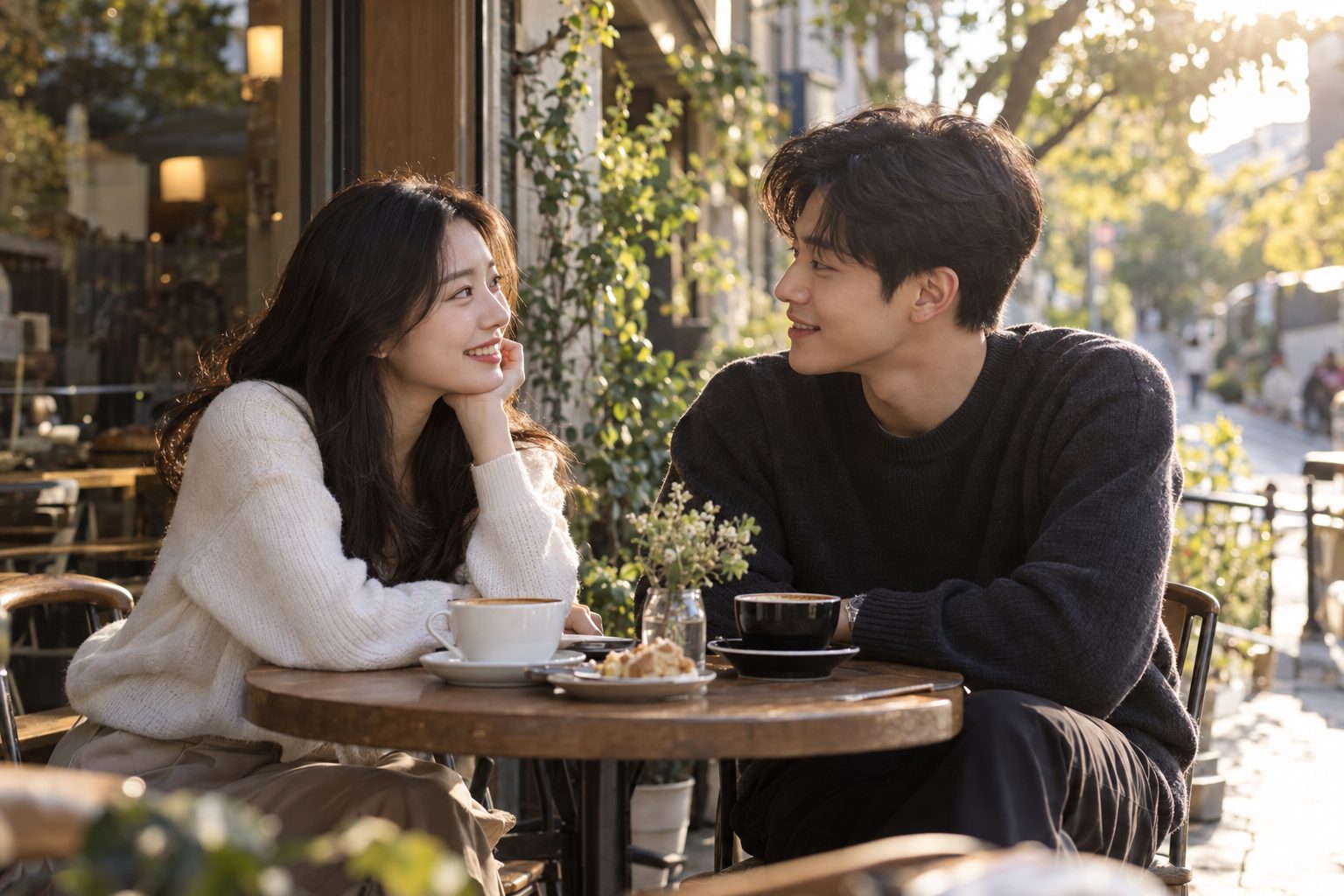
It’s 10:40 on a weeknight. You’ve had dinner, then coffee, then a second coffee because neither of you wanted to leave. At the subway station you say, “I’m fine from here, go home!”
He does not go home. He says “데려다줄게” (“I’ll take you”), rides three stops in the wrong direction, walks you to your building, waits until the door closes behind you, and then gets back on the subway for a 50-minute trip home. Seven minutes later your phone buzzes:
“잘 들어갔어?” (“Did you get in okay?”)
Then, at 11:35: “나 도착. 잘 자.” (“I’m home. Sleep well.”)
If you grew up somewhere where “text me when you get home” is something only your mother says, this can feel either lovely or slightly like being tracked by a very polite satellite. For a lot of Korean men, it’s simply what a boyfriend does.
The short version: Korean dating tends to have a clear start date, frequent check-ins on KakaoTalk, visible “we’re a couple” signals, and a lot of care shown through actions rather than words. Who pays is shifting from “the man pays” toward sharing. Military service and parents’ opinions shape the timeline. None of it decides who your boyfriend is, but knowing the script helps you tell “this is him” from “this is just how dating works here”.
The relationship has a birthday
In much of the West, people drift from dating into a relationship, and “are we exclusive?” can hang in the air for weeks. Korean dating usually draws a line.
Before the line is 썸 (sseom, from the English “some”, as in “something going on”). You 썸 타다 (“ride the some”): late-night chats, a movie, a lot of “so… what are we?” energy that nobody says out loud. Many Korean relationships start with a set-up date through a friend, and our guide to 소개팅 blind dates walks through that whole pipeline.
Then comes the 고백 (go-baek), literally “confession”. Someone says “우리 사귈래?” (“Shall we go out?”) or the more dramatic “나랑 사귀자” (“Go out with me”). If the answer is yes, that day is day one, and from then on you are 사귀는 사이, officially going out.
This matters because, for many couples, the clock starts there. Korean couples commonly celebrate 100 days (백일, baek-il), then 200, 300, a year, and some march on to 1,000 days. Couple apps count it for you, and most count the first day as “1”, so day 100 arrives a day earlier than your maths says. Add Valentine’s Day, White Day on March 14, Pepero Day on November 11 and Christmas Eve, which in Korea is a couples’ night out rather than a family night in. If he plans something for day 100, he’s not being over the top. He’s being on time.
KakaoTalk, all day long
Then the messages start, and they do not stop. 잘 잤어? (Did you sleep well?) 점심 뭐 먹어? (What are you having for lunch?) 퇴근! (Off work!) 뭐 해? (What are you doing?) 잘 자 (Sleep well).
The word that governs all of this is 연락 (yeol-lak), keeping in touch, and it’s serious business. In a 2023 survey of 300 single adults by the matchmaking company Duo, 84% of those with dating experience said they’d fought with a partner over 연락. The top cause, named by just over half, was replying too slowly. In second place: not being reachable during a night of drinking, picked by 28.2% of men and 33.6% of women. Only 9.3% said a couple didn’t need to be in touch every day.
So if he texts you a photo of his lunch with no comment, that is not a mistake. It’s a love letter, written in kimchi stew.
The same survey has a twist every long-term couple will recognize: 57% said their message frequency had changed since the early days, and of those, 92.4% said it had gone down, mostly because both people got busy. The month-one “good morning ☀️ did you eat? 🥺” turns into the year-two “ㅇㅇ” (yep). That’s not a crisis. That’s comfort.
The KakaoTalk details, from the little unread “1” to emoticons, are in our KakaoTalk etiquette guide. For dating, the practical move is to agree on a rhythm early: “I can’t text much at work, but I’ll message at lunch and when I’m home.”
One line worth drawing clearly. Checking in is couple culture. Demanding your location all day, reading your phone or getting angry when you see friends is controlling behavior. That isn’t a Korean custom, and you don’t have to accept it.
Care you can see: rides, shrimp and carrying the bag
Many Korean men, especially those raised by more traditional parents, grew up in homes where “I love you” was rarely said out loud. Care was done. That’s 정 (jeong): affection built through small acts and time.
So watch what he does:
- He walks you home, or waits until your taxi leaves. And then he texts to check you got in.
- He makes sure you’ve eaten. “밥은 먹었어?” (“Did you eat?”) is a hug in question form. (Here’s why Koreans ask that.)
- He peels the shrimp, grills the meat and cuts it with scissors, then puts the best pieces on your side of the grill. At a Korean BBQ this is a quiet declaration of devotion.
- He shows up with cold medicine when you mention a sore throat, even if you didn’t ask.
- He holds your bag while you try on clothes. Stand outside any Seoul department store fitting room and you’ll spot a few young men holding handbags that are clearly not theirs, with the calm of guards protecting a national treasure.
Words may come later, or in writing. Plenty of Korean men who struggle to say 사랑해 (“I love you”) out loud will write a heartfelt letter for day 100. Keep it. You’ve just been given the speech he couldn’t make.
“Oppa”, “nuna”, and why age still sets the tone
If he’s older, you may end up calling him 오빠 (op-pa), literally what a younger sister calls her older brother and the standard word Korean women use for an older boyfriend. Many Korean men melt a little when they hear it. If he’s younger, you’re his 누나 (nu-na), and the younger-boyfriend romance (연하남, yeon-ha-nam, “younger man”) has its own fan club in dramas. The full story of these titles, including the infamous “오빠 믿지?” (“You trust oppa, right?”), is in our guide to oppa, unnie, hyung and noona.
Age shapes more than names. In the traditional script, the older partner (often the man) leads: picks the restaurant, plans the date, pays more. Many couples now ignore that script, but you’ll still feel its echo. Here’s why Koreans ask your age before your name.
Who pays: the counter wrestling match, and the 6:4 compromise
Some Korean men still feel that paying is part of being a good boyfriend. Many couples, especially in their 20s and 30s, alternate, split or pool money. The numbers show a culture in the middle of changing its mind.
In a Gayeon survey of 506 single adults aged 25 to 39, published in September 2026, one date cost an average of 115,000 won. Men said they spent about 145,800 won per date and women about 84,000 won. Asked what a fair split would be, respondents landed around 6:4, men to women. And 17.8% said money had caused a fight, most often because one side paid little or nothing.
Common patterns you’ll see:
- Taking turns. He gets dinner, you get coffee and dessert. This is the most graceful system ever invented.
- The date account (데이트 통장, de-i-teu tong-jang). Both put in the same amount each month and dates come out of the shared pot.
- Whoever earns more pays more. Common when one is a student and one has a salary.
If he says “내가 쏠게” (“I’ll treat you”, literally “I’ll shoot”), let him, and take the next round. What you want to avoid is the famous Korean counter wrestling match: two people lunging for the bill, wallets drawn, the cashier frozen like a referee who never trained for this. Nobody wins. Settle the system over coffee, not at the till.
Couple T-shirts, couple rings, and how much skinship in public
Matching 커플티 (couple T-shirts), couple rings, couple phone cases and matching sneakers are a very visible part of Korean dating. Couple rings around day 100 are common. If he suggests matching padded jackets for winter, he’s not being strange. In his world, it’s a cheerful way of saying “we’re together” to the whole street. You’re allowed to negotiate down to matching socks.
Public affection, or 스킨십 (seu-kin-sip, Konglish for physical touch), tends to be milder than in many Western countries. Holding hands, linking arms and leaning on each other on the subway are normal. Long kissing in public can earn looks, especially from older people on that same subway, who will stare with the intensity of film critics.
The army is part of the story
Most Korean men do mandatory military service, about 18 months in the army and longer in the navy and air force, usually in their early 20s. That shapes dating in two ways.
First, timing. Men often finish university later and start work later, and many feel “behind” on savings and career when they get out. That feeling tends to show up right when relationships turn serious. In 2024, the average age at first marriage in Korea was 33.9 for men and 31.6 for women, according to Statistics Korea.
Second, feelings. Couples who date through enlistment face a famous test of patience, with its own slang and its own drama storylines. If he’s already served, ask about it with curiosity, not as a joke. If he hasn’t, talk about it early. Our military service explainer covers the branches, the service lengths and the “rubber shoes” phrase every Korean couple knows.
Meeting his parents is a big step
In many Korean families, being introduced to the parents means the relationship is serious, sometimes “we’re thinking about marriage” serious. Some couples date for years before it happens. Parents’ opinions, mothers’ especially, can carry real weight, which ties into the strong duty to parents called 효 (hyo).
If he says “우리 엄마가 너 보고 싶대” (“My mom wants to meet you”), the gift, the clothes, the bow and the questions you’ll face are all in our guide to meeting a Korean partner’s parents.
Why it works this way: “연애” is newer than you think
The word for dating itself, 연애 (yeon-ae), is a fairly modern import. According to an essay in the National Institute of Korean Language’s journal, 연애 as a word for romantic love between a man and a woman came from a Japanese translation of the English word “love”. It began appearing in Korea in the early 1910s through translated and adapted novels, and by the early 1920s it had become an explosive buzzword.
Before that, under Joseon’s strict Confucian norms, marriages were arranged by parents and matchmakers, and romantic passion wasn’t something you discussed in polite company. A 1913 newspaper novel had to go out of its way to argue that its two lovers, who chose each other without parents or a go-between, felt something “pure and sacred”, not something shameful.
A century later, many Koreans choose their own partners, but traces of the old system remain: the matchmaking friend, the formal family meeting, the sense that a relationship is quietly heading somewhere. The 100-day parties and couple T-shirts are the newest layer, built on top of a culture that only recently started saying “dating” out loud.
When he goes quiet
The flip side of showing care through action is that problems can also be shown rather than said. Short replies, “그냥” (“just because”) or “아니야, 됐어” (“No, forget it”) can mean “something’s wrong, please notice.” Koreans call this 삐지다 (ppi-ji-da), to sulk, and it’s an equal-opportunity sport. Everyone does it.
If you come from a culture of talking things through, a gentle direct question works wonders:
Say / Mean: “화났어? 솔직하게 말해 줘. 나 안 삐질게.” (hwa-nass-eo? sol-ji-ka-ge mal-hae jwo. na an ppi-jil-ge) means “Are you upset? Tell me honestly. I won’t sulk.” It opens the door without accusing him, and the promise at the end makes him laugh, which is half the battle.
(More on reading between the lines in why Koreans rarely say no directly.)
The K-drama myths
A few things dramas get wrong, or at least exaggerate:
- The wrist grab is not a love language. It’s a drama trope.
- The piggyback ride after you twist your ankle is rarer than dramas suggest. Most real boyfriends will call a taxi and buy you a pain-relief patch at the convenience store. Honestly, more useful.
- “Who is this man?! She’s MY woman!” jealousy, delivered in a rainstorm, is not romantic in real life. It’s a red flag.
- The chaebol mother with an envelope of cash telling you to leave her son is, statistically speaking, not waiting for you at the café.
- Not every Korean man is a gentle flower-carrying romantic. Some are. Plenty aren’t. Like everywhere.
What to do and say: a practical cheat sheet
| Situation | Try saying | What it does |
|---|---|---|
| He insists on walking you home | “고마워, 도착하면 연락해!” (“Thanks, text me when you’re home!”) | Returns the care instead of refusing it |
| He pays for dinner | “커피는 내가 살게” (“Coffee’s on me”) | Keeps things even without a fight |
| You’ll be out drinking | “오늘 친구들이랑 술 마셔. 집 가면 연락할게” (“Drinking with friends tonight, I’ll text when I’m home”) | Prevents the #2 fight in the survey above |
| He goes quiet | “무슨 일 있어?” (“Did something happen?”) | Opens the door gently |
| Day 100 is coming | “백일에 뭐 하고 싶어?” (“What do you want to do for 100 days?”) | Shows you know the calendar |
Common mistakes:
- Going silent for a whole evening out. One text before the drinks start saves a lot of trouble.
- Waiting for him to say everything out loud. Notice the rides, the shrimp, the medicine.
- Fighting over the bill at the counter. Agree on a system early.
- Joking about his military service before you know how he feels about it.
- Treating meeting his parents as casual. Prepare, or ask him what it means in his family.
- Accepting control as “culture”. Check-ins are normal. Surveillance isn’t.
Every relationship writes its own rules. But knowing the ones he grew up with makes it much easier to write yours together, ideally over a second coffee, followed by a long, unnecessary subway ride to your door.