Dating & Marriage · 연애 · 10 min read
Dating a Korean girlfriend: the unwritten rules (and the ones you can ignore)
'Did you eat?', '서운해', '아무거나', 100 days, couple photos, who pays, 'oppa', her friends' verdict and her parents. The Korean dating habits worth knowing, why they exist, and how to talk about them without stereotypes.
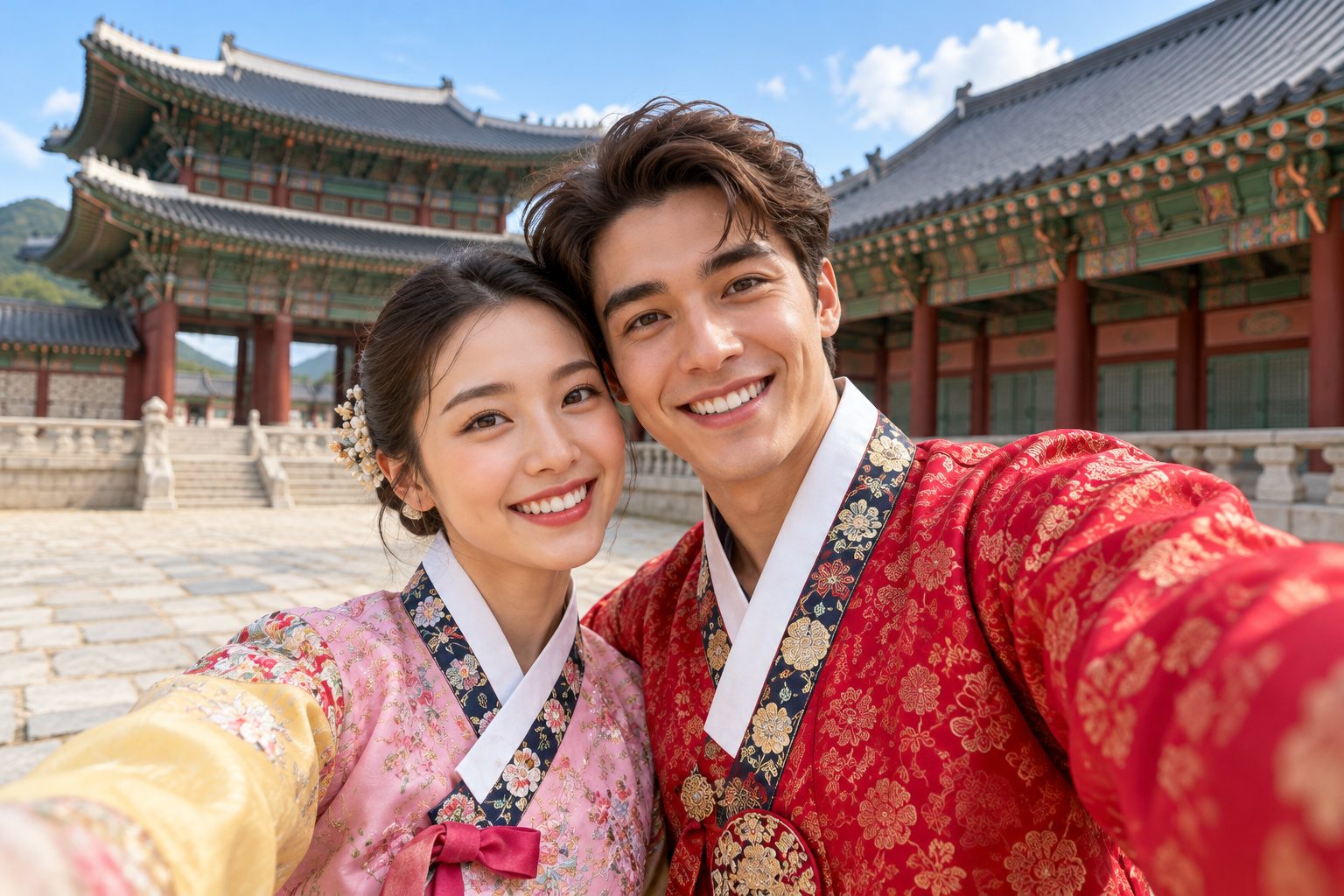
You’ve been seeing someone in Seoul for a few weeks. It’s going well. Then, at 12:40 on a Tuesday, a message: “밥 먹었어?” (“Did you eat?”).
You reply “yes”, because you did. Then you stare at the screen. Was it an invitation? A test? Should you have said what you ate? Is “yes” too short? You type “yes, did you?”, delete it, type “yes!! 😊”, delete that too, and somewhere a sandwich goes cold.
Mostly, it was hello with a hug in it. In Korea, asking whether someone has eaten is one of the most common ways to say I’m thinking about you (we explain why in Why Koreans say “Have you eaten?”). The perfect answer is short, a tiny detail, plus the question back: “응, 김밥 먹었어. 너는?” (“Yep, had gimbap. You?”). Bonus points for a blurry photo of the gimbap.
That’s a good model for this whole article. There are recognizable habits in Korean dating, and knowing them saves you a lot of confusion. But there’s no manual for “the Korean girlfriend”. Treat each habit as a question worth asking her, not a rule she must follow.
The short version: expect daily check-ins, a clear start date and a 100-day celebration, playful couple items and photos, a money system you work out together, and a few small words (서운해, 아무거나, 괜찮아) that carry more feeling than their dictionary size. Meeting her friends and parents is a real step. And the internet’s “Korean girlfriend” stereotypes are mostly noise.
(The companion piece, dating a Korean boyfriend, covers the walk home, the survey on texting fights, the army and who spends what on a date. This one takes different scenes, and a lot of both applies either way.)
The check-ins, and the tiny “1”
Many Korean couples message through the day on KakaoTalk: good morning, lunch?, leaving work, home now, good night. Keeping in touch has its own word, 연락 (yeol-lak), and “he/she doesn’t keep in touch” is one of the most common complaints in Korean relationship advice.
The small messages are the affection. “뭐 해?” (“What are you doing?”) rarely wants a status report. It usually means “I’m a bit bored and I thought of you.” The right answer is not “Working.” It’s “일하는 중 ㅠㅠ 너 생각하고 있었어” (“Working, ugh. Was just thinking of you”).
Then there’s the little yellow “1” beside a message on KakaoTalk, which disappears once it’s been read. Korean even has slang for its worst outcome: 읽씹 (ik-ssip), short for “read and ignored”. Leaving her on 읽씹 for three hours while you’re clearly online is the kind of thing that gets discussed in her friends’ group chat with screenshots. The full anatomy of that “1” is in our KakaoTalk etiquette guide.
What works: say early how your days run. “I can’t text during meetings, but I like hearing from you and I’ll reply when I’m free.” That’s a boundary, not a rejection.
What doesn’t count as culture: demands to share your location around the clock, hand over passwords or account for every hour. That’s a relationship problem, in any country.
서운해: the most important word nobody translates well
Sooner or later you’ll hear it: “좀 서운했어.” Dictionaries say 서운하다 means feeling that something fell short, a sense of regret or disappointment. English tries “hurt”, “let down”, “a bit sad”, and misses a little every time.
It isn’t angry. It’s closer to “I expected you to notice, and you didn’t.” You forgot she had a big presentation and didn’t ask how it went. You made weekend plans with friends without mentioning it. You replied “ㅇㅋ” (OK) to a long message she spent ten minutes writing. Nothing terrible happened. Something small went missing.
Say / Mean: “서운했겠다. 미안해, 내가 신경 못 썼네.” (seo-un-haet-get-da. mi-an-hae, nae-ga sin-gyeong mot sseon-ne) means “That must have felt disappointing. I’m sorry, I didn’t pay attention.” It names her feeling first and owns your part second, which is exactly the order 서운해 is asking for.
What doesn’t work: explaining, point by point, why she shouldn’t feel 서운. You’ll win the argument and lose the evening.
아무거나 and 괜찮아: the two-word puzzles
You ask what she wants for dinner. “아무거나” (“Anything”).
You suggest pasta. “음… 어제 먹었어.” Burgers? “좀 느끼할 것 같아.” (A bit greasy.) Korean BBQ? “옷에 냄새 배잖아.” (My clothes will smell.) Twenty minutes later you’re both eating tteokbokki, which she suggested, and it’s delicious.
Before you laugh too hard: Koreans of every gender do this. It’s such a universal couples’ comedy routine that the joke “아무거나 isn’t on the menu” practically writes itself. Usually 아무거나 means “I don’t want to be the one who decides, but I’ll know the wrong answer when I hear it.” The trick is to offer two specific options: “떡볶이 아니면 국밥?” (“Tteokbokki or gukbap?”). Choosing between two is easy. Choosing from the whole city is not.
“괜찮아” (“It’s fine”) is the other one. Said with a smile, it means it’s fine. Said flatly, after a pause, while looking at her phone, it may mean please ask me one more time. Not always. Ask once more, kindly: “진짜 괜찮아? 말해 줘도 돼.” (“Really fine? You can tell me.”) (More on indirect signals in why Koreans rarely say no directly.)
애교: cute on purpose
You may meet 애교 (ae-gyo), the deliberately cute voice, pout or gesture: stretching words out (“오빠아~”), finger hearts, a sulky “힝”. The Standard Korean Language Dictionary defines 애교 (愛嬌) as “an attitude that looks cute to others”. Amusingly, the same dictionary lists a second 애교 (愛校) meaning “loving your school”, so technically your university alumni association is also full of aegyo.
Some Korean women do it naturally with a partner, some find it cringe and never do it, and plenty of Korean men do it too, as any variety show where a male idol is forced to perform aegyo will show you. Don’t request it as if it were a feature of the model. If it happens, enjoy it. If it doesn’t, she’s not broken.
Day one, day 100, and a calendar full of couple days
Korean couples usually know exactly when they started dating: the day someone asked “우리 사귈래?” (“Do you want to go out with me?”) and the other said yes. Couples count from there, with day one as “1”, and the 100-day mark (백일, baek-il) is the first big celebration. Some keep going to 200, 300 and 1,000 days.
Add the calendar: Valentine’s Day, White Day (March 14), Christmas Eve (a date night in Korea more than a family night) and, for the enthusiastic, a themed “couple day” on the 14th of every month. Then there’s Pepero Day on November 11, when the stick-shaped chocolate snacks stand in for 11.11. Its origin is surprisingly sweet: it reportedly started in the mid-1990s among schoolgirls in Busan and the surrounding region, swapping Pepero as a joke wish to “stay as slim as a Pepero stick”. The manufacturer, Lotte, only started officially celebrating it in 1997, after customers kept asking about it.
Does your girlfriend care? Some love it. Some find it cheesy. Some forget. Ask: “백일 챙기는 거 좋아해?” (“Do you like celebrating 100 days?”). It’s a much better way to find out than missing it. A small, thoughtful plan usually beats an expensive gift.
Couple outfits, couple rings, and you as the photographer
Matching sneakers, matching hoodies, couple phone cases and couple rings (often around day 100) are a visible, cheerful part of Korean dating. If she suggests matching jackets and you’d rather die, say so kindly and offer a middle ground: matching rings, matching keyrings, the same color but different clothes.
Then there are the photos. Korean couples love a photo booth strip from one of the self-photo studios that fill every university neighborhood, complete with props: oversized glasses, headbands with ears, a tiny hat. And at a café with nice light, you may be promoted to photographer. Expect to take thirty near-identical shots, crouch for a lower angle, and hear “다리 길게!” (“Make my legs long!”). It’s teamwork. Your reward is the one photo she picks, which will become her profile picture, which is a quiet public announcement that you exist.
Who pays, and the date account
You’ll find confident claims online that “Korean men always pay” or that “everyone splits now”. The data says: a bit of both.
In a 2023 Duo survey of 500 single adults, 5:5 was the most common way couples split date costs (about 40% of both men and women). But the next answers leaned one way: men often said they paid 7:3 or 6:4, and women most often said 4:6. About one in four had used a date account (데이트 통장, de-i-teu tong-jang), a shared pot both partners pay into each month.
The objections are very practical, and a little funny. People who disliked the idea worried about fighting over who forgot to transfer their share, and about how to divide the balance after a breakup. Romance, meet accounting.
You’ll hear “내가 쏠게” (“I’ll treat you”). It’s a generous offer, and the graceful move is to treat next time. If money starts to feel uneven or stressful, talk about it directly. Arguing over the bill at the counter is the one approach almost everyone agrees is worst.
Oppa, jagi and the switch to 반말
If you’re an older man dating a Korean woman, she may call you 오빠 (op-pa). It literally means “older brother” when a woman says it, and it’s the standard warm word for an older boyfriend. Couples also use 자기 (ja-gi, roughly “honey”) and private nicknames. The whole family of titles, and the jokes around them, are in our guide to oppa, unnie, hyung and noona.
Two cautions. First, don’t ask to be called oppa because a drama made it sound romantic. Some women use it naturally, others don’t like it. Second, a couple may start in polite speech and drift into casual speech (반말, ban-mal) as they get closer. That switch can feel like a milestone, but it shouldn’t be demanded as proof of love. Some partners stay polite out of habit or because of an age gap, and that’s fine. Our guide to when to speak 반말 covers what the switch feels like. (Grammar lives on Korean Toolbox.)
Skinship (스킨십, physical affection) follows a similar pace: holding hands and linking arms in public is normal, while long public kissing is less so. Follow her lead.
Her friends: the review panel
Being introduced to her friends means you’re entering her world, and you are, gently, being reviewed. Expect group meals with shared dishes, personal questions (age comes up fast: here’s why) and some teasing. If one of those friends set you two up, treat her like royalty. Our 소개팅 guide explains what a thankless job matchmaking is.
This is where 눈치 (nun-chi), reading the room, helps: notice who’s oldest, who’s quietly pouring drinks, and when the evening is winding down. Learn a few greetings, ask her friends about themselves, pour for others before yourself, and don’t make her translate every sentence all night. The verdict will arrive later in a group chat you will never see. “착해 보여” (“He seems kind”) is a strong pass.
Her parents
In many Korean families, meeting the parents means the relationship is serious, sometimes “we’re thinking about marriage” serious. In others it’s a casual dinner. Ask her what this particular meeting means and what would make it comfortable. The gift, the clothes, 어머님 and 아버님, the bow and the questions are all in our guide to meeting a Korean partner’s parents.
How it’s changing: dating isn’t automatically a marriage track
Older Korean couples often dated with marriage in view. That assumption is weakening, especially among young women. In Statistics Korea’s 2024 Social Survey, just 26.0% of unmarried women said people should marry, compared with 41.6% of unmarried men. The top reason given for not marrying was not having enough money to marry (31.3%), and among unmarried women a notable 19.1% said they simply didn’t feel the need. Meanwhile 67.4% of all respondents said a couple can live together without marrying, up from 56.4% in 2018.
What that means for you: don’t assume where things are heading, in either direction. She may be dating for the joy of it, or she may already be picturing a Chuseok table with you at it. The only way to know is to ask.
Ignore the internet’s “Korean girlfriend” myths
Plenty of online guides claim Korean women are more jealous, more traditional, more demanding or more devoted than women elsewhere. That flattens millions of people into one personality type. It’s also risky: if you believe possessiveness is “just the culture”, you might put up with things you shouldn’t. If you expect a drama heroine, you’ll miss the real person in front of you.
Culture explains customs. It doesn’t decide who she is.
Five conversations to have early
- How often do we like to talk during the day?
- Which dates matter to us? Birthdays, 100 days, holidays, gifts or no gifts.
- How do we handle money? Turns, a shared account, or something else that feels fair.
- What does meeting friends or parents mean for us?
- How do we fight? Some people want to talk it out now, others need time. Agree on how to come back to it.
Common mistakes
- Answering “Did you eat?” with only “yes”. Add a detail and ask back.
- Leaving messages on 읽씹 for hours. A quick “바빠, 이따 연락할게” (“Busy, I’ll message later”) takes three seconds.
- Arguing her out of 서운해. Acknowledge it first.
- Answering 아무거나 with “OK, you choose then.” Offer two options instead.
- Demanding oppa, 반말 or aegyo because a drama made it look cute.
- Assuming the relationship’s direction from a survey or a stereotype, including this article.
None of these are uniquely Korean. That’s the point: knowing the culture gives you better questions, and the answers belong to the two of you. Start with the easiest one, at 12:40 on a Tuesday: “응, 너는?”